
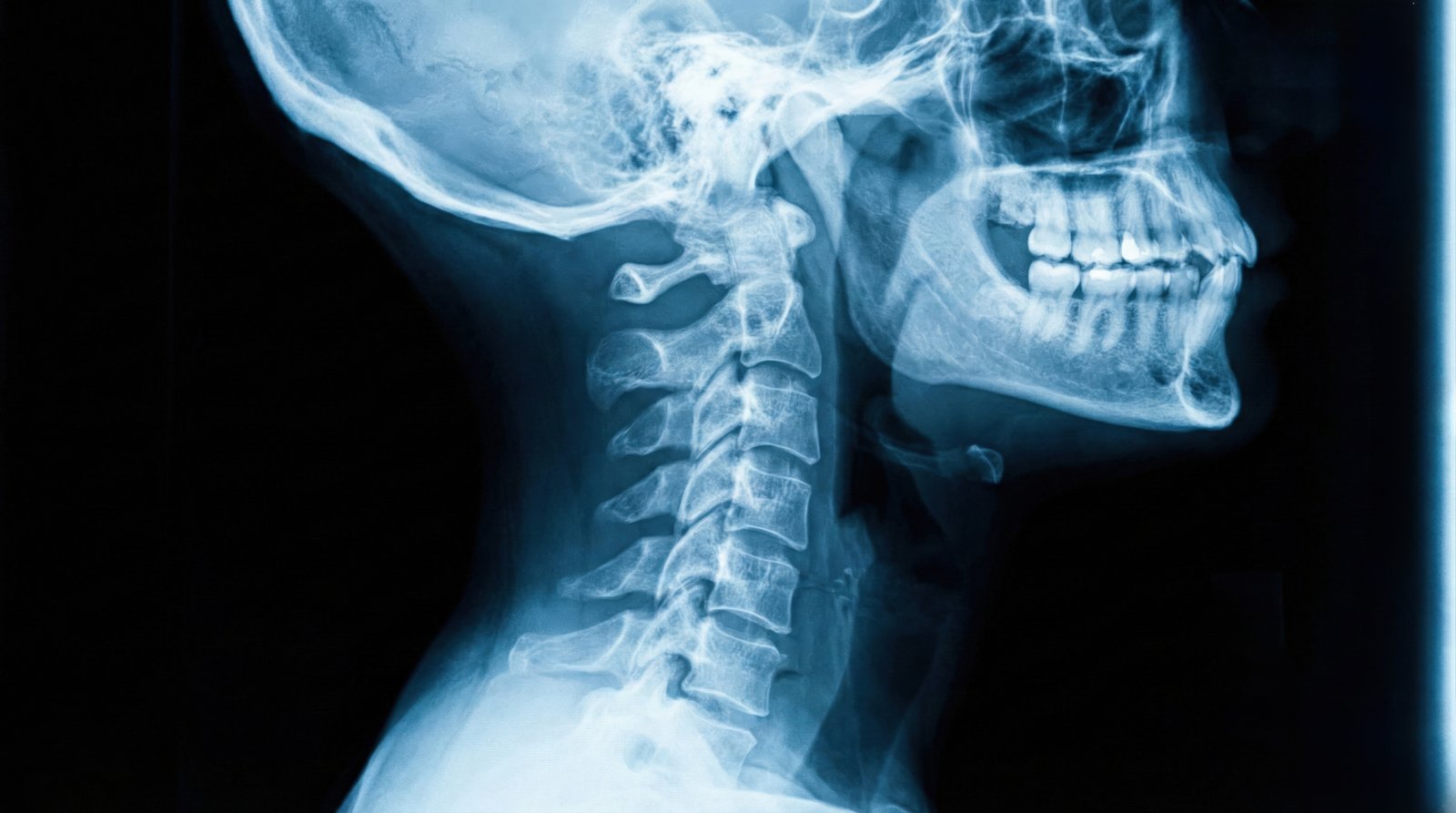
Dr. Charla Fischer, a board‑certified orthopedic spine surgeon in New York City whose practice focuses on the cervical spine, performs anterior cervical discectomy and fusion (ACDF). If your MRI report or your surgeon has said “C5-C6”, this post explains what that level is, why it matters for your arm symptoms, and what an ACDF there involves.
What “C5-C6” Means
C5-C6 is the disc and joint between the fifth and sixth bones of your neck. It sits low in the neck, just above C7, and carries much of the load of the head above it. According to Spine-health, this level is frequently affected by disc herniation and wear-and-tear degeneration.
The nerve that leaves the spine at this level is the C6 nerve. When a disc or bone spur presses on it, the symptoms tend to follow that nerve’s path:
- Pain: in the shoulder, upper arm, forearm and hand, often worse with neck or arm movement.
- Numbness or tingling: along the thumb side of the forearm, the thumb and the index finger.
- Weakness: around the shoulder, elbow and wrist.
The C6 nerve is one of the most commonly affected in the neck. In a population study from Rochester, Minnesota, C7 was the nerve involved most often, followed by C6.
Most People Get Better Without Surgery
Surgery is not the first step. The AAOS notes that most people with a pinched nerve in the neck get better over time, and that initial treatment is nonsurgical: a short period in a soft collar, physical therapy, anti-inflammatory medication, a short course of oral steroids, or a steroid injection near the nerve. In the Rochester study, 90% of patients were free of symptoms or only mildly limited at last follow-up, and about a quarter had surgery.
Dr. Fischer’s own page on cervical radiculopathy describes the same order: medication, physical therapy, a soft collar or injections first, with surgery reserved for the most serious cases.
When Is an ACDF at C5-C6 Considered?
Surgery may be recommended when arm pain, numbness or weakness has not improved with nonsurgical care, or when the nerve or spinal cord is getting worse. The Cleveland Clinic also lists progressive weakness and spinal cord damage as reasons ACDF may be advised. Pressure on the cord itself is called cervical myelopathy, and ACDF is one of the ways it is treated.
A surgeon looks at whether your symptoms match the C6 nerve, what your MRI shows, and how your strength, sensation and reflexes compare on examination. A disc that looks worn on an MRI is not, by itself, a reason to operate: the AAOS points out that nearly half of middle-aged and older adults have worn discs and pinched nerves that cause no symptoms at all.
What Happens During a C5-C6 ACDF
As Dr. Fischer’s ACDF page explains, the spine is reached from the front of the neck by going through existing muscle planes. The C5-C6 disc or bone spur is removed, and a graft is placed between the C5 and C6 vertebrae so they heal together. A plate holds the bones in place while they heal.
The AAOS describes the incision as 1 to 4 inches along a crease in the neck. Restoring the height of the disc space gives the nerve more room to leave the spine. The Cleveland Clinic notes that the operation itself usually takes one to two hours.
Three Ways to Treat a Pinched C6 Nerve
ACDF is the most commonly performed operation for a pinched nerve in the neck, according to the AAOS, but it is not the only one. Dr. Fischer also performs artificial disc replacement and posterior cervical foraminotomy.
| ACDF | Artificial disc replacement | Posterior foraminotomy | |
|---|---|---|---|
| Approach | Front of the neck | Front of the neck | Back of the neck |
| What is removed | The disc and any bone spurs | The disc, replaced with an implant | Bone and tissue over the nerve, sometimes part of the disc |
| Motion at C5-C6 | Stopped by the fusion | Designed to be kept | Often kept, as a fusion is not always needed |
The comparison comes from the AAOS, which adds that disc replacement is more recent than fusion: its short-term results are comparable, and long-term results are still being researched. Which one fits depends on where the pressure is, the health of the disc, and whether the spinal cord is involved, and that is decided at a consultation.
Recovery
For ACDF in general, the AAOS says many patients stay one night in hospital and some go home the same day; most walk and eat on the first day. Range-of-motion and strengthening exercises typically begin at 4 to 6 weeks, and the fusion may take 6 to 12 months to become solid. The Cleveland Clinic adds that many people return to work within three to six weeks with their surgeon’s approval and to regular activities by three to four months. These are typical ranges, not a schedule.
Dr. Fischer’s week-by-week ACDF recovery guide walks through each stage.
Risks
The AAOS lists the risks of any neck surgery as infection, bleeding, nerve or spinal cord injury, a reaction to anesthesia, a tear in the covering of the nerves, symptoms that are not relieved, and needing more surgery later. Approaching from the front adds soreness or difficulty swallowing, voice changes, injury to the esophagus, problems with the implants, and the fusion not healing. Difficulty swallowing solid food and some hoarseness for a few weeks are common. The Cleveland Clinic also notes that, rarely, the levels next to a fusion can wear and need treatment later. Dr. Fischer reviews the risks that apply to you before surgery.
How to Get Help
If arm pain or numbness has been traced to C5-C6 and it isn’t settling, a consultation can sort out whether the nerve needs more time, a different treatment, or surgery. Dr. Fischer sees patients at NYU Langone Center for Musculoskeletal Care, 333 East 38th Street, 6th Floor (646-501-7200), and NYU Langone Madison Orthopedic Surgery Associates, 145 East 32nd Street, 4th Floor (212-427-3986). Contact Dr. Fischer to schedule a consultation.
Sources: AAOS, Cervical Radiculopathy (Pinched Nerve); AAOS, Cervical Radiculopathy: Surgical Treatment Options; Radhakrishnan K, et al. Epidemiology of cervical radiculopathy. Brain. 1994;117:325-35; Cleveland Clinic, ACDF Surgery (reviewed Feb 2024); Spine-health, All About the C5-C6 Spinal Motion Segment; AANS, Herniated Disc; Dr. Fischer’s ACDF, cervical radiculopathy and cervical myelopathy pages.
Frequently Asked Questions
What causes problems at the C5-C6 level?
Most often, age-related wear of the disc and the bone spurs that form around it, or a disc herniation. Spine-health notes that C5-C6 carries much of the load of the head and is frequently affected by degeneration, herniation and injury. The AAOS adds that in younger people a sudden injury is the more common cause.
Is a C5-C6 ACDF a major surgery?
Yes. The Cleveland Clinic describes ACDF as a major surgery, while noting that most people go home the next day and are off pain medication within two to three weeks. The operation itself usually takes one to two hours. Your surgeon will explain what your own operation involves.
Will I lose movement in my neck after a C5-C6 fusion?
Motion stops between C5 and C6 only. The Cleveland Clinic notes that these vertebrae were usually not very flexible before surgery, and that many people don’t notice a change in their flexibility afterward. The rest of the neck keeps moving.
What if C6-C7 is affected as well?
When discs at two neighboring levels are both pressing on nerves, an ACDF can treat both in one operation, joining three vertebrae instead of two. Dr. Fischer’s post on two-level ACDF explains what changes when more than one disc is treated.
How successful is ACDF?
The Cleveland Clinic reports a success rate of 85% to 95% for ACDF, and the AAOS says most patients have favorable outcomes, with relief from pain and a return to daily activities after recovery. Results vary from person to person, and some patients need more surgery later.