
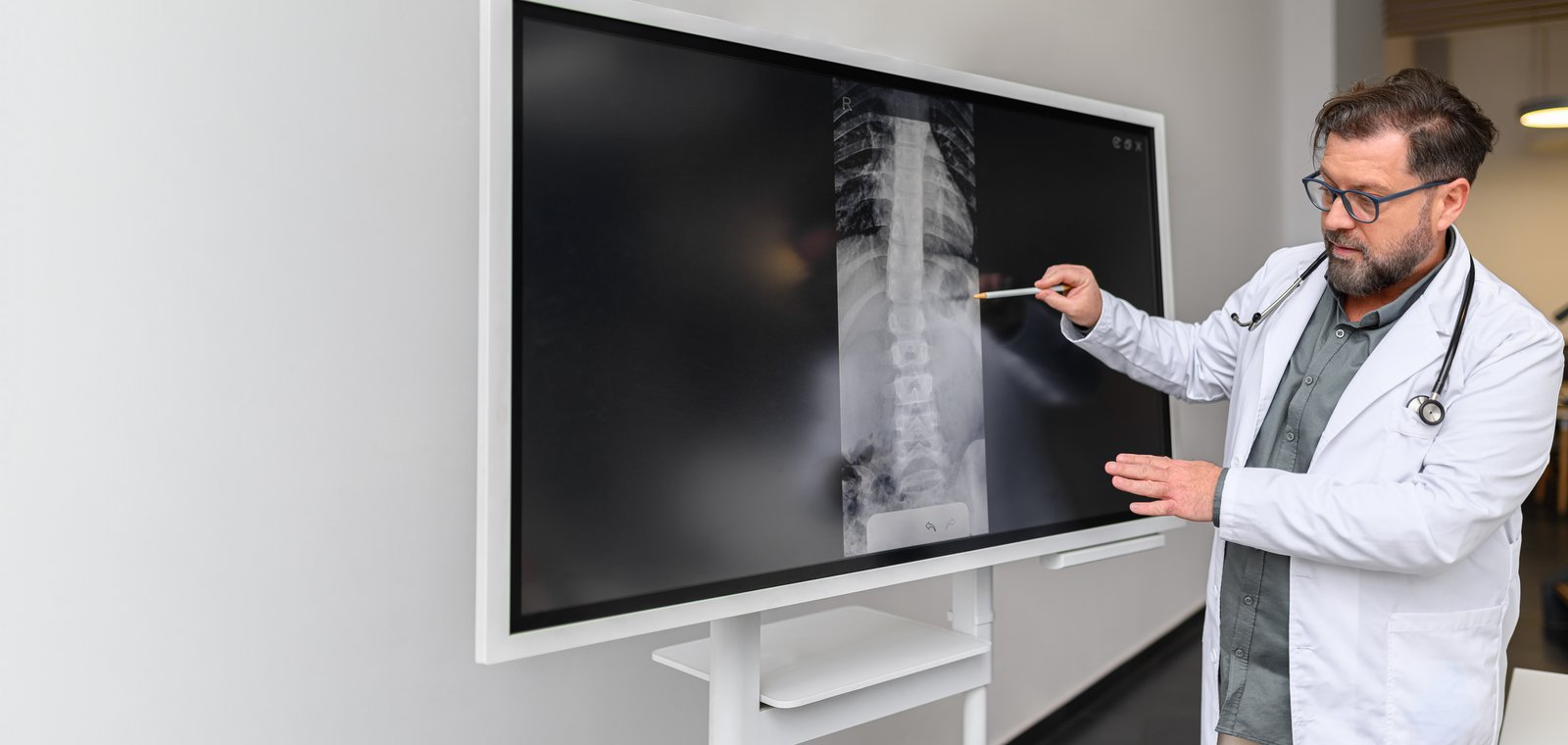
Dr. Charla Fischer, a board‑certified orthopedic spine surgeon in New York City, performs minimally invasive lumbar spinal fusion. L5-S1, the lowest level of the lumbar spine where it meets the sacrum, is one of the levels most often fused. Here is why, and what the operation and recovery involve.
What Is an L5-S1 Fusion?
A spinal fusion joins two vertebrae so that motion no longer occurs between them. As Dr. Fischer’s minimally invasive lumbar spinal fusion page explains, bone graft is placed between the vertebrae, and the body heals the graft over several months, similar to a fracture healing, joining the bones together. The lack of motion at that level is what helps decrease back pain. An L5-S1 fusion joins the fifth lumbar vertebra (L5) to the top of the sacrum (S1).
Why L5-S1?
Dr. Fischer’s posts on minimally invasive lumbar fusion note that L4-5 and L5-S1 are the levels most often treated. The lowest lumbar levels are also well suited to fusion from the front, because the disc space there often needs the most restoration of height to relieve the cause of pain.
A fusion at L5-S1 may be recommended for:
- Degenerative disc disease: a painful, worn disc.
- Spondylolisthesis: a vertebra that has slipped over the one below it, making that level unstable.
- Deformity: correcting an abnormal curve.
Pinched nerves are often treated at the same time. Removing the bone or soft tissue pressing on the nerves (a decompression, such as a laminectomy) is often done together with a fusion, and the removed bone can be used as graft.
How the Fusion Is Done
All fusion approaches place bone graft between the vertebrae. The spine can be reached from the back (posterior), from the front (anterior) or from the side (lateral). Screws, rods, plates or cages support the spine while the graft heals.
| Approach | How the spine is reached | Example |
|---|---|---|
| Anterior | Through the abdomen, avoiding the back muscles | ALIF |
| Posterior | Through the back | TLIF |
| Lateral | From the side | Lateral interbody fusion |
In a minimally invasive fusion, small incisions are used instead of the traditional midline incision, which means less muscle damage and a faster recovery. Dr. Fischer recommends the approach based on each patient’s anatomy and condition.
Surgery and Recovery
A straightforward anterior fusion at L5-S1 takes about one to two hours. Many patients having a single-level fusion walk the day of surgery and go home the next day. The fusion itself matures over about three to six months, and your surgeon will follow its progress at your visits.
How Well Does It Work?
For anterior lumbar interbody fusion, successful fusion is reported in at least 90% of cases, and many studies report more than 95%. Results vary from person to person.
Risks
Every approach has its own risks. For the anterior approach, reported complications include injury to the large blood vessels in front of the spine (1–2%), retrograde ejaculation in men (about 1%), infection (1%), and a temporary slowing of the bowels (ileus, about 2%). Dr. Fischer reviews the risks of the approach she recommends with each patient before surgery.
How to Get Help
If you’ve been told you may need a fusion at L5-S1, a consultation can explain which approach fits your spine and what recovery would look like for you. Dr. Fischer sees patients at NYU Langone Center for Musculoskeletal Care, 333 East 38th Street, 6th Floor (646-501-7200), and NYU Langone Madison Orthopedic Surgery Associates, 145 East 32nd Street, 4th Floor (212-427-3986). Contact Dr. Fischer to schedule a consultation.
Sources: Hospital for Special Surgery, ALIF Surgery (updated Oct 2025); Cleveland Clinic, Laminectomy (warning signs after lumbar surgery); Dr. Fischer’s minimally invasive lumbar spinal fusion page and lumbar fusion posts.
Frequently Asked Questions
Why is L5-S1 fused so often?
L4-5 and L5-S1 are the lumbar levels most often treated with fusion. The lowest levels also tend to need the most restoration of disc height, which makes them well suited to a fusion done from the front of the spine.
How long does L5-S1 fusion surgery take?
A straightforward anterior fusion at L5-S1 takes about one to two hours. More complex operations take longer, depending on anatomy and how many levels are treated.
How long is recovery after an L5-S1 fusion?
Many patients having a single-level fusion walk the day of surgery and go home the next day. The fusion itself matures over about three to six months, and your surgeon will follow its progress at your visits.
What is the success rate of lumbar fusion?
For anterior lumbar interbody fusion, successful fusion is reported in at least 90% of cases, and many studies report more than 95%. Results vary from person to person.
Is minimally invasive fusion different from traditional fusion?
Both place bone graft between the vertebrae and support the spine with hardware while it heals. A minimally invasive fusion uses small incisions instead of the traditional midline incision, which means less muscle damage and a faster recovery.